No, But You Did Laugh
Sarah Laughs, God Ponders

Not doing it…
I mean, that first big covenant between Abraham and God, the circumcision thing, the one that begat the renaming of Avram and Sarai. It does not call for, require, or frankly inspire a piece of music.
What would that sound like, anyway? I don’t remember my own bris, which I assume was on my eighth day. I do remember my son’s bris, the mohel, the giving of Magen David wine to an eight-day-old (nice!), but nothing musical comes to mind. Fear? Yes, but not in any musically constructive way. Maybe something queasy?
But no. Not going there.
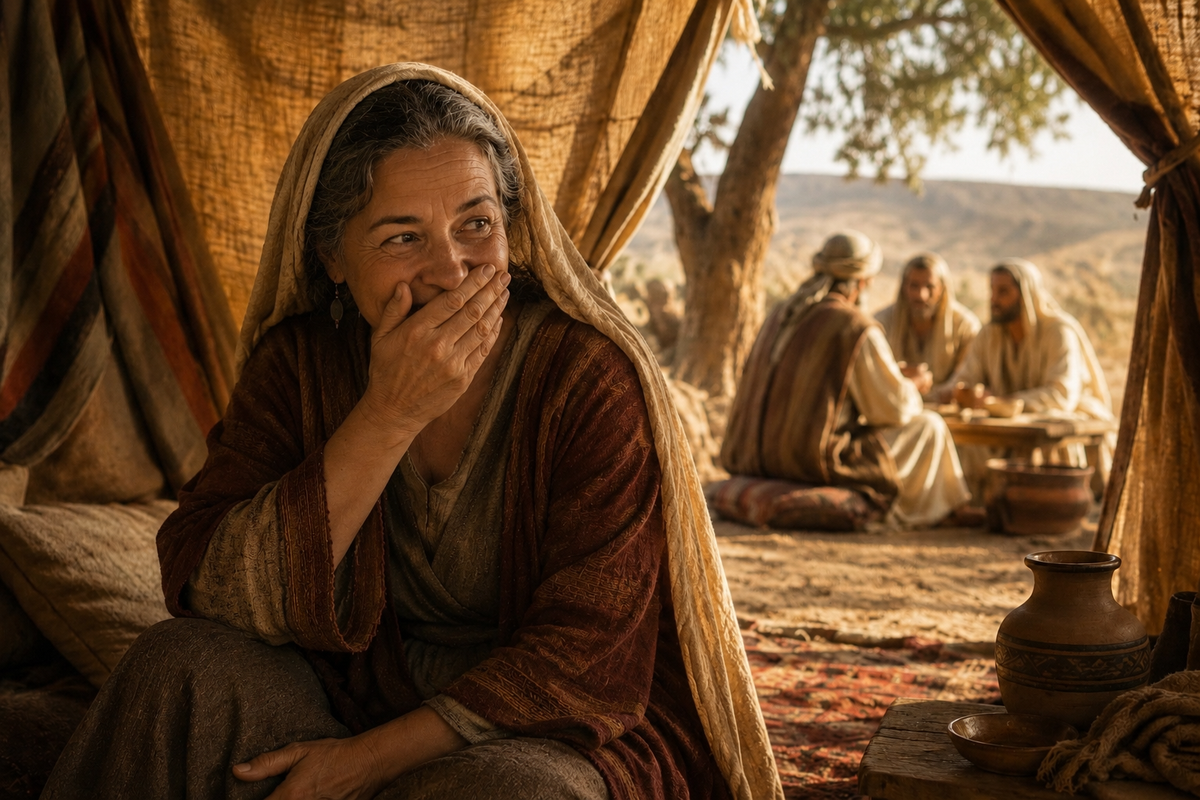
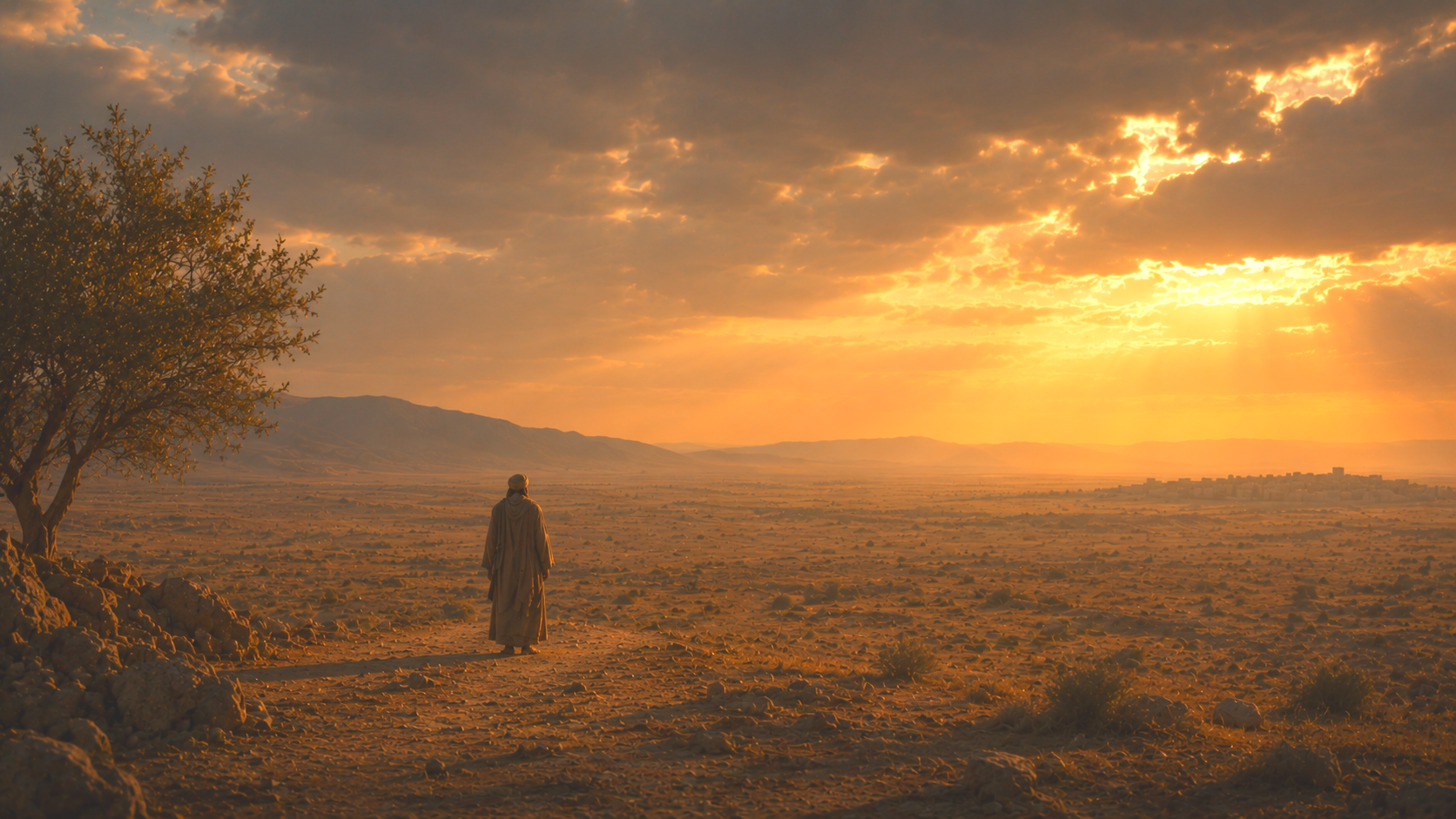
And then I thought about the next chapter in Genesis, and Sarah laughing. This is one of my favorite “scenes” in the Bible. Sarah overhears the big G (or one of his angels) telling Abraham that she will bear a son. She’s 90, and
had stopped having the way of women. And Sarah laughed inside her and said, “After I’ve become worn out am I to have pleasure?! And my lord is old!”1
God is annoyed by Sarah’s laugh:
And YHWH said to Abraham, “Why is this? Sarah laughed, saying, ‘Shall I indeed give birth? And I am old!’ Is anything too wondrous for YHWH?”
Sarah, fearful, lies and says, “I didn’t laugh.” God says, “No, but you did laugh.”
Thus, all Jewish humor through the millennia is born.
The whole exchange is, to my way of thinking, hysterical. (You can almost hear Sarah as a modern-day sarcastic bubbie.) Of course, the problem may be my way of thinking, which may be wrong: I am forever misinterpreting information, biblical and otherwise, for my own creative purposes.
For example, when I had my bar mitzvah at age 40, my haftarah portion included the scene in which David brings the Ark triumphantly into Jerusalem, dancing with such abandon that his wife watches from a window and is scandalized—partly because the king may have revealed rather more of himself than royal decorum allowed. David is unapologetic. In my commentary, I compared him to Elvis.
I never really consulted with our very learned rabbi about this. Why? Because I didn’t want my creative process disrupted. My interpretation may have been wrong, or irreverent, or both. But part of the creative process is allowing yourself to be wrong. Sometimes that’s how you find something new.
When I was maybe 32, after our first daughter was born, I decided I needed to read the Torah. This was perhaps precipitated by my wife bringing up the idea of Shabbat and Shabbat dinners. I was hesitant. She eased me into it by lighting candles. She had grown up with all this—Shabbat dinners, Jewish day school, a bat mitzvah at the appropriate age, Hebrew.
Me? I was Jewish, and I knew it.
I went to Sunday school for a while; my dad brought in a Hebrew tutor. Nothing stuck.
But I was feeling a certain pull. In my teens, I read a ton of Jewish history but never the Tanakh. So I bought a copy of the JPS Tanakh with the goal of reading the whole thing.
I did manage to get through the Five Books. But that edition had no commentary, just the text. When I first met our rabbi at our suburban Chicago synagogue, I remarked that I had read the entire Torah without commentary. Speaking of laughing, he laughed at me. Rightly so.
“Why would you do that?”
“I wanted to experience it for the first time without being prejudiced by other people’s ideas,” I lied.
In truth, I probably bought the cheapest version available, which wasn’t the King James Version. I couldn’t read Hebrew, and wasn’t going to read Elizabethan English. And I may not have known there was such a thing as commentary when I first started reading it.
But my point was not entirely wrong. Sometimes not knowing—or approaching something for the first time without first being told what other people think it means—can be enlightening. You may see something you otherwise would have missed.
Returning to our Sarah laughing example. When I now read the classic commentaries on this exchange—Rashi or Ramban, for example—I don’t find much interest in the humor. I find thoughtful analysis of why Sarah laughed, and why God admonished her for doing so, etc. Interesting, but…boring.
You see, if I had read that commentary while reading for the first time, I may have missed what I see as deadpan humor.
How is this not funny? The king of the universe is having this ridiculous exchange with Sarah. Obviously, he knows she laughed, omniscience and all. And she knows he knows.
It’s funny without trying to be funny, which is why it’s funny. It’s all the funnier because there is no follow-up. It just moves on.
The agents, or angels of God, leave Abraham and Sarah and head toward Sodom. Abraham sees them off.
You can imagine Sarah, slightly bemused, maybe a little scared at offending El Shaddai, but mostly considering the distinct possibility that she’ll be having sex with a 100-year-old guy later that evening.
And then, suddenly, the scene changes:
And the people got up from there and gazed at the sight of Sodom, and Abraham was going with them to send them off.2
They’re heading for the big showdown at Sodom. Sarah disappears from the story. And then God pauses.
What follows feels almost like a Shakespearean soliloquy—a rare moment in which we overhear God deliberating with himself:
And YHWH had said, “Shall I conceal what I’m doing from Abraham, since Abraham will become a big and powerful nation, and all the nations of the earth will be blessed through him? For I’ve known him for the purpose that he’ll command his children and his house after him, and they’ll observe YHWH’s way, to do virtue and judgment, and for the purpose of YHWH’s bringing upon Abraham what He spoke about him.”
In this internal dialogue, God seems to be questioning his own methods, mulling over whether it’s a good idea to let Abraham in on his plan to destroy Sodom for its many evils. Why would God want to conceal it?
When I first read this, the moment seemed utterly unconnected to the scene of Sarah laughing. A non sequitur. The angels—or agents—have left Abraham and Sarah, and then God has this moment.
But reading it again, I wonder whether the soliloquy of Divine Doubt is somehow precipitated by Sarah’s own moment of doubt. What I saw as funny may have been anything but to God. Did Sarah’s laughter somehow make him momentarily uncertain?
Did her disbelief, however fleeting, cause even God to pause and reconsider his own approach?
Sarah laughs, and suddenly even God pauses.
This improvisation is in two parts: first piano trio—very busy, particularly in the drums. Then the rhythm section drops out suddenly at 2:30, and it’s solo piano in a gospel-blues style. That moment is special: make sure to listen to the whole thing.
- Biblical quotations are from Richard Elliott Friedman's Commentary on the Torah (HarperCollins, 2001).
Thanks for reading Musically Novel! This post is public, so feel free to share it.
THE TANAKH IMPROVISATIONS
I’m collecting the tracks in an ongoing playlist. Click below…I’ve included a bonus track at the end.