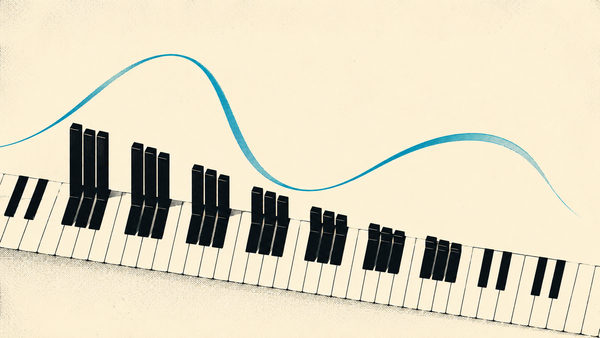
Leave and Don't Come Back
Lech Lecha לֶךְ־לְךָ


The first command given to the first Jew is not “believe,” “submit,” or “obey.” It is “go.”
לֶךְ־לְךָ
Lech lecha.
The phrase is famously layered. Go forth. Go for yourself. Go to yourself.
That last possibility interests me. Perhaps the point of leaving is not only to reach another place, but to become capable of reaching yourself. Leave your land, your birthplace, your father’s house — not because home is meaningless, but because home is not the whole of you.
My friend Homayoon Zarean, who knows what it’s like to leave home in the worst possible way, wrote beautifully about improvisation and faith as versions of the same act: beginning a journey without knowing the destination. He was writing in the context of Jacob’s ladder, but the idea applies here too. Perhaps it applies to much of the Hebrew Bible.
You start.
You do not know if it will work.
You do not know where it will lead.
But you go.
Every true improvisation is this way. Every true journey is this way. No guarantees. At best, you discover something by moving.
Finding the Theme
That is also what makes free improvisation both thrilling and dangerous. Without a fixed destination, you may discover a new musical world. You may also go nowhere. A lot of notes may add up to less than the sum of their parts.
So what is the difference between music that wanders and music that journeys?
Maybe it has something to do with theme.
In music, whether improvising or composing, the aim is often to discover the theme, or themes. I say “discover” because, in improvisation especially, you don’t always know at first. Sometimes it is the first thing you play. Sometimes you have to go a ways, play some notes, find a groove, before the theme reveals itself.
Did Abram know his theme in advance?
Not really.
He knew only that he had to go. The meaning would emerge later.
This improvisation begins with a simple, almost comfortable theme in E-flat major — Beethoven’s heroic key, at least if one is thinking of the Eroica.
OPENING THEME
But almost immediately, C minor shadows it: the relative minor, and for Beethoven often a tragic key. The sweetness is real, but it is already being challenged.
COUNTER-THEME
Something is immediately fighting the plain sweetness, reaching higher and higher until, becoming more intense, around 1:35, something breaks.
Flight
The fugue-like motif emerges, seemingly out of nowhere.
FUGUE MOTIF

It is as if the striving can no longer sustain the sweetness.
The music leaves home.
The quasi-fugue starts simply and keeps building, accumulating voices, motion, and pressure until it becomes a full-blown rock n’ roll fugue. It was not planned. When I reached it, I remember feeling only: this has to happen.
Fugue comes from the Latin fuga: flight.
Take flight.
We also speak of fugue states: sudden departures from ordinary life, sometimes accompanied by lost memory and the assumption of a new identity.
I am not suggesting Abram experiences anything like that in a clinical sense. He does not forget his past. But he does eventually assume a new identity: Abraham. And after he leaves, he never quite returns. His old home remains in the story, but not as a place he can simply go back to.
Abraham later sends his servant back to “my land and my birthplace” to find a wife for Isaac. But Isaac himself is not to go back. The old home remains a source, a memory, a point of origin — and, apparently, a place to find a woman. But it is not the future.
That may be what happened musically. Even as the fugue developed, I felt an obligation to find my way back to the original theme. I never really did. There are hints of it, traces of it, as if the music is trying to remember home but cannot completely recover it.
Nor, intuitively, does it really want to.
Becoming Abraham
Abram leaves without a plan, but with a promise:
“Go forth from your land, from your birthplace, and from your father’s house, to the land that I will show you.”
The wording is emotionally brutal. Leave your land. Hard. Leave your birthplace. Harder. Leave your father’s house. Harder still.
And go where?
To the land that I will show you.
Not the land I have shown you.
The land I will show you.
Abram receives no map.
But he goes.
And this is where the story becomes more interesting than the usual “journey of faith” version. Abram hears the call and goes. Then famine comes, and he panics. In Egypt, afraid he will be killed, he tells Sarai to say she is his sister, risking her for his own survival. Later, when the promise of descendants seems delayed, he and Sarai try to force the future into being through Hagar. Even after the covenant, after the name change, after becoming Abraham, he repeats the sister-wife deception with Abimelech.
The call is real.
The transformation is not instantaneous.
He is becoming Abraham, but Abram keeps coming along for the ride. He can’t quite shake him.
That, to me, is one of the great truths of the Hebrew Bible. Its central figures are not saints. They are flawed human beings who hear something, move toward it, fail, compromise, panic, argue, and continue.
Abram never really arrives, does he?
He keeps going.
As the first Jew, perhaps he is the perfect prototype. You hear something — God, conscience, hope, a higher frequency. You struggle to reach it. You will never quite get there. But you keep moving.
Home
Which brings me back to my improvisation’s opening motif.
I wanted to return to it. I really did. I kept trying to remember my thematic home, but I never quite made it back. All I could do was hint at it.
RETURN THEME
Why?
Of course, not every leaving is chosen. Some people leave because they are called. Some leave because they must. My friend Homayoon was exiled from Iran and can only return if the Islamic regime falls and the Iranian people are freed from its tyranny. Jews were exiled and returned. Abraham leaves and does not return, though home remains inside the story.
So maybe this improvisation is about that whole cycle: leave, arrive, lose, remember, return — or discover that return is no longer possible in the way you imagined.
Or maybe it is just notes following their own path.
Lech lecha.
THE TANAKH IMPROVISATIONS
I’m collecting the tracks in an ongoing playlist. Click below…I’ve included a bonus track at the end.