10. Model Home Away From Home

This is an ongoing story, meant to be read in order. If you’re just arriving here for the first time, please start at the beginning by following the index.
I sometimes feel like I’m part of a large controlled study at my school. A bunch of kids—ages four to eighteen with every personality type—stuffed in a small space to see what happens.
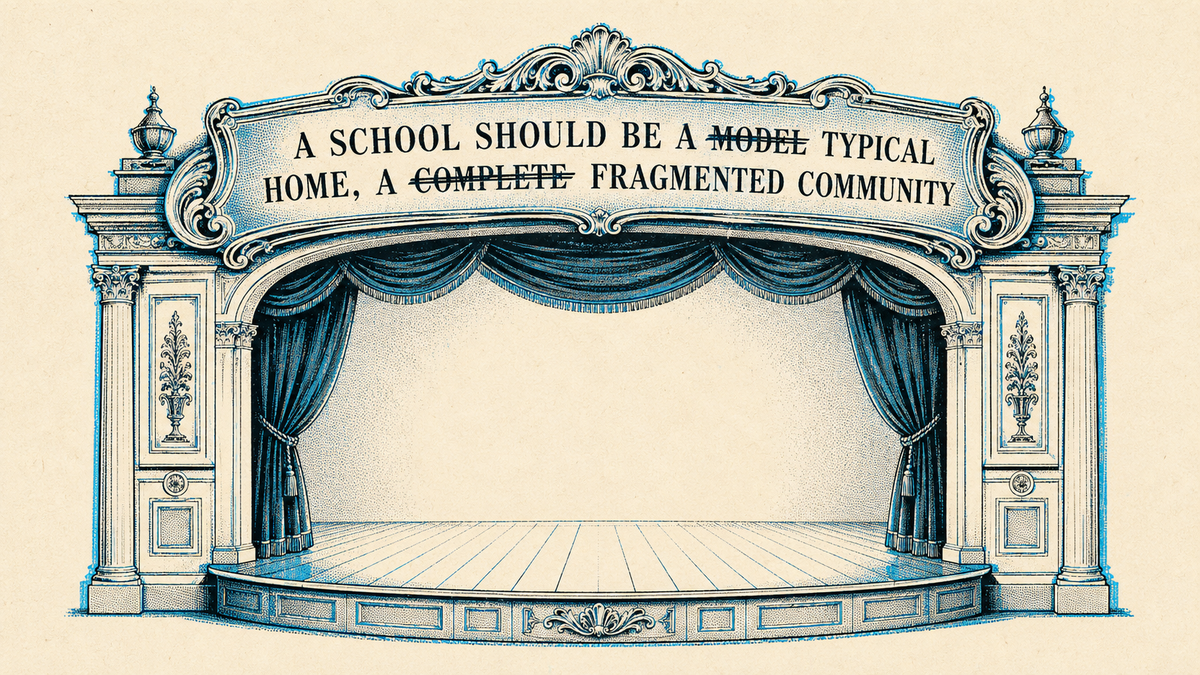
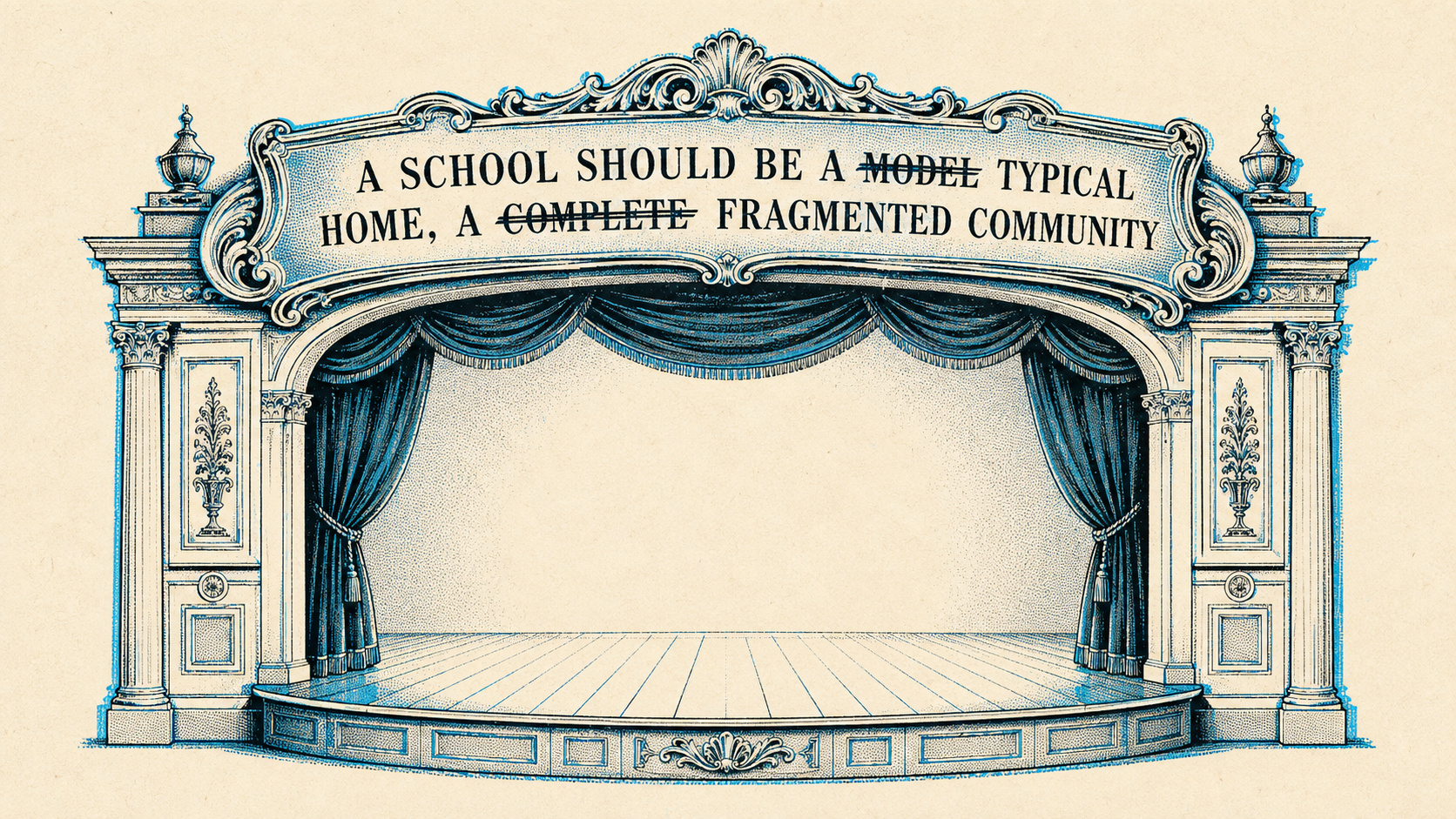
Francis W. Parker School’s motto is written in serifed silver letters above the auditorium’s proscenium:
A school should be a model home, a complete community, an embryonic democracy.
Well, that explains it. This really is a carefully controlled experiment. We’re the subjects… the faculty, my fellow students, me. The ideas inherent in that motto, vague as they might be, are being indoctrinated into us from the beginning.
We’re part of a noble experiment that would tear down the rigid Teutonic walls of the standard American public school education. Except the reality on the ground is that it’s neither all that careful nor all that controlled. It is—as with all halfway decent human institutions—barely contained chaos.
Our little focus group is made up of the usual lot of secondary-school archetypes, found at any school—private, public, or sectarian.
The aforementioned bullies.
Class clowns.
Saints and sinners.
Social climbers—and the socially withdrawn.
Smart and dumb asses.
Analytical and creative types.
Dreamers.
Loners.
Sociopaths.
Although we don’t know it yet, we’re collectively on our way to becoming…
Drug dealers, occupational therapists, movie stars (several).
Tech millionaires, religious zealots, slum landlords.
Superstar journalists, magazine editors, tennis pros.
CPAs, corporate lawyers, mayoral candidates.
Under Secretaries of State, sports announcers, family planners.
Interior and game designers.
Photographers, chefs, comedians.
Novelists, screenwriters, chemists.
Nazi sympathizers, singer-songwriters, vintners.
Cosmeticians, cosmetologists, swindlers.
Rhodes Scholars, suicides, tenured/adjunct professors.
Corporate titans, bartenders, political activists.
Gangsters, hair and song stylists.
Spanish teachers, diamond merchants, quilters.
Jazz musicians, high school principals, philologists.
Real estate agents, developers, urban planners.
Self-absorbed thespians, mathematicians, horror film auteurs.
The fact I’d interact with this variety of humanity in my grade of 50-60 students—plus the adjacent three or four grades—is a testament to something, but I’m not quite sure what.
No, I’ll tell you what it’s a testament to. Even at a fairly exclusive school—one priding itself on being progressive, democratic, and inclusive—there’s still going to be, at the end, a certain percentage of Hollywood starlets, Republicans, Marxists, and drug addicts. Also, a few very good and very bad musicians.

I remember the teachers.
Perverts, possible pedophiles, idiots.
Brilliant English professors, tough-guy football coaches, and at least one cheerful-but-alcoholic history teacher.
Clarinet-playing art teachers, trumpet-playing math teachers, and an actual music teacher who was almost too enthusiastic about his job.
A pert, blonde, Texan Spanish teacher; a math teacher who was a former Chicago Republican (almost unheard of) alderman; and saintly special-ed types—one of them helped me learn to read in first and second grade.
An eighth-grade homeroom teacher had been a sergeant in the Vietnam War. He liked to run his class with military-like precision, but would occasionally laugh at his own absurdity. His sweet daughter was in my class. Thankfully for her, she wasn’t in her father’s homeroom. She’d often roll her eyes at his antics, as if to say, What are you going to do? That’s just him doing his army thing.
A soulful, forgiving principal who let me graduate even though I regularly missed his morning biking class, which could have meant my being one credit shy of the required load.
Teachers having affairs with other teachers.
In short, the students and faculty were the usual assortment of humanity acting in ways that were generally less than model, community-oriented, or democratic. Acting as people almost always do—in their own sometimes enlightened, often deluded self-interests.
Of course, nobody will ever put that above the school auditorium’s proscenium:
A school should be a typical home, fragmented community, and a broken democracy.
Next Chapter: 11. Pequeños Bebés!